


RNG in crypto casinos is what decides every spin, card draw, or dice roll you see on screen. It’s the background system that picks the outcome before anything happens, even though players never actually see it working.
The problem is that RNG often gets misunderstood. Some players assume it guarantees fairness in every session. Others think it creates streaks, remembers past results, or reacts to big wins. In reality, RNG does something much simpler and much more limited than most people expect.
This guide explains how RNG works in crypto casino games, why casinos rely on it, how it differs from provably fair systems, and what randomness can and can’t actually tell you while you’re playing. The goal isn’t to defend casinos or sell a system; it’s to make the mechanics clearer so game results feel less mysterious and easier to understand.
What Is RNG?
A random number generator, usually called an RNG, is the system that decides outcomes in crypto casino games. It’s what picks the result of a slot spin, determines which card is dealt, or sets the number on a dice roll, all before anything appears on screen.
The important thing to understand is that the number comes first. The game visuals come after. When you spin a slot or click “roll”, the RNG immediately generates a number. The game then maps that number to an outcome you can see on screen. The animation isn’t deciding anything; it’s just showing you the result that was already picked.
This is how online casino games stay consistent. Each action is treated as a fresh event, with no memory of what happened before. The RNG doesn’t know if you’re on a winning streak, chasing a loss, or just started playing. Every result is generated independently.
In crypto casinos, RNGs are usually software-based and run continuously in the background. They’re designed to keep producing new numbers whether anyone is betting or not. When you place a wager, the game simply takes the next number in line and uses it to determine the result.
That’s the foundation everything else is built on. Once you understand that RNGs generate outcomes first and visuals second, a lot of common confusion around “patterns” and “hot streaks” starts to make more sense.
Why Crypto Casinos Rely on RNG Systems
Crypto casinos rely on RNG systems because there’s no physical element involved in digital play. There’s no real deck being shuffled, no dice being thrown, and no wheel being spun. Everything happens in software, so randomness has to be created artificially.
An RNG fills that gap. It replaces physical chance with a system that can produce unpredictable results instantly, at scale. Without it, games would either be predictable or manipulable, which would break the entire concept of casino play.
There’s also a simple practical side to it. Crypto casinos have a lot of games running at once, often with thousands of players betting at the same time. An RNG lets each game produce its own result independently, without waiting on anything else.
Just as importantly, each bet is handled on its own. What happened on the last spin or hand doesn’t carry over, and one player’s result has no effect on anyone else. That’s how digital games avoid becoming predictable, even though everything is happening in software.
How RNG Outcomes Are Generated
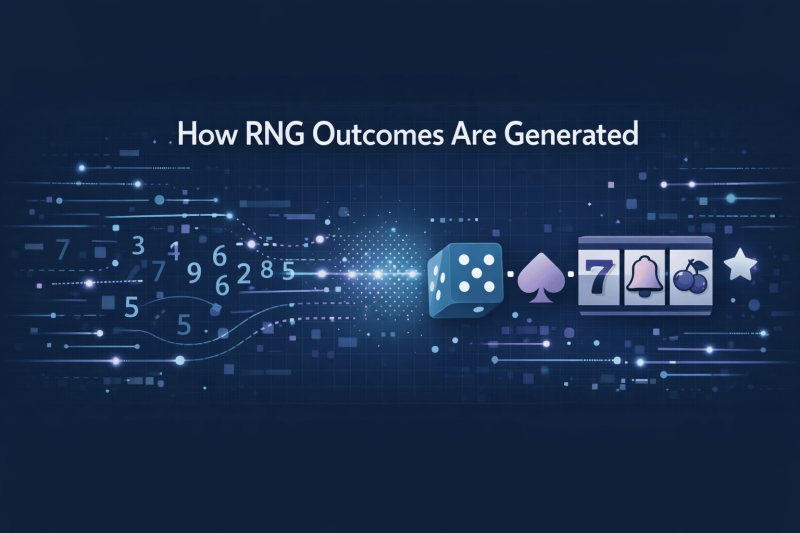
Behind the scenes, an RNG is constantly producing numbers. In most crypto casino games, those numbers are generated the moment you place a bet, not when the animation finishes or the result appears on screen.
The game then takes that number and translates it into something meaningful. In a slot, it might map to reel positions. For a card game, it might decide which card comes next. Finally, in dice, it becomes the final roll. You never see the number itself, only how the game uses it.
What matters here is that the number is generated first, and everything you see afterward is just presentation. The spin, shuffle, or roll animation doesn’t influence the outcome. It’s there to show you the result, not create it.
This is also why refreshing a page, changing your bet size at the last second, or waiting longer between spins doesn’t affect what happens. Once the bet is placed, the RNG has already done its job.
RNG in Crypto Casino Games
RNG doesn’t show up the same way in every casino game. Even when the same system is used underneath, the way results are delivered can feel very different depending on what you’re playing.
Below, we look at how RNG is applied across common crypto casino games, and why slots, table games, dice, and crash games all feel so different in practice, even though randomness is doing the work in every case.
How RNG Works in Slots
With slots, everything is decided at once. You hit spin, the game pulls a random result, and that result already includes whether you win, lose, trigger a feature, or hit nothing at all.
The reels spinning on screen don’t affect anything. They’re just showing you the outcome that was picked the moment you placed the bet. That’s why slots can feel quiet for ages and then suddenly do something, or drain a balance faster than expected without any warning.
Each spin is its own thing. The game isn’t warming up, cooling down, or reacting to what happened before.
How RNG Works in Table Games
Table games tend to feel different because the randomness shows up in smaller pieces. Instead of one big decision, the game pulls a result whenever it needs one, like the next card or the next number.
In something like digital blackjack, nothing is pre-decided beyond the next draw. The game simply asks the RNG for the next card when it’s needed, then carries on from there. Roulette is similar. The result comes from a single number, but it isn’t tied to a bigger, all-at-once outcome the way a slot spin is.
Because results are spread out over multiple steps, table games tend to feel calmer. Wins and losses usually come in smaller chunks, even though the randomness underneath is still doing the same job.
RNG in Dice Games
Dice games are one of the most direct uses of RNG. Each roll produces a number within a set range, and the outcome is settled immediately.
The player can choose targets or odds, but the RNG still decides the number. Changing settings doesn’t influence the randomness itself, only how wins and losses are calculated after the number appears.
Because results are quick and repetitive, dice games can feel very mechanical. There’s no buildup or animation hiding the outcome, which makes the role of RNG easier to see, even if players don’t think about it that way.
RNG in Crash-Style Games
Crash games feel different because the outcome is usually decided before the round even starts.
An RNG sets the crash point, and the multiplier climbs until it hits that number. Players aren’t reacting to randomness in real time, they’re deciding when to exit before the pre-set crash happens.
This is why crash games can feel brutal. A round might look like it’s “due” to go higher, but the result was already locked in. Timing feels important, but it doesn’t change what the RNG already decided.
How RNG Is Used Across Different Casino Game Types
The way RNG is used also depends on the type of game you’re playing. Even with the same underlying system, the experience can feel very different.
| Game type | How RNG is applied | When randomness occurs | How it feels in play | What players usually notice |
| Slots | RNG decides the full outcome in one go | At the moment you spin | All-or-nothing, big swings | Long dry spells, sudden wins |
| Blackjack (digital) | RNG decides each card as it’s drawn | One card at a time | More gradual, step-by-step | Wins and losses feel earned |
| Roulette | RNG selects a single number | At the spin result | Quick and decisive | Results feel instant and final |
| Dice games | RNG generates a number within a range | Each roll | Fast, repetitive | Clear win/loss boundaries |
| Crash-style games | RNG sets the crash point before the round | Before the round starts | Tense and unpredictable | Early exits vs big risks |
RNG vs Provably Fair in Crypto Casinos
RNG and provably fair are often talked about as if they’re competing systems, but they’re really two different ways of handling trust. Both are used to generate random outcomes, but only one lets players check what happened after the fact.
Traditional RNG systems work behind the scenes. You’re told the game is random, and you’re expected to trust that the software is doing what it claims. Provably fair systems take a different approach by exposing parts of the process so results can be verified once a round is finished.
Understanding the difference matters in crypto casinos, where transparency is often part of the appeal and players aren’t relying on the same trust assumptions as they would in traditional online gambling.
How RNG-Based Games Handle Trust
In standard RNG-based games, trust sits with the casino and the software it uses. The game generates an outcome, shows you the result, and that’s the end of it. There’s no way for a player to look back and confirm how that result was produced.
That doesn’t automatically mean the game is unfair. Many RNG systems are tested and certified, and most operate exactly as intended. But from the player’s point of view, everything happens behind the scenes. You’re relying on the casino to run the system correctly and not interfere with outcomes.
For players used to traditional online casinos, this model feels normal. In crypto casinos, though, some players expect more visibility than RNG alone can provide.
How Provably Fair Systems Change That Model
Provably fair systems don’t replace randomness; they change how it’s handled. Instead of asking players to trust the outcome, they allow the result to be checked after the round is finished.
The game still produces a random result, but it also leaves a trail of data that can be used to confirm nothing was changed along the way. Players don’t need to verify every result for the system to matter. The value is knowing that verification is possible if something looks off.
This approach fits naturally with crypto casinos, where transparency and user control are already part of the wider ecosystem. It doesn’t guarantee wins or better odds, but it removes the need to take fairness on faith alone.
RNG vs Provably Fair: A Practical Comparison
RNG and provably fair both aim to produce random results, but they don’t treat transparency the same way. The table below shows where they differ once you look past the surface.
| Aspect | RNG-Based Games | Provably Fair Games |
| How outcomes are generated | Internally by casino software | Generated using cryptographic inputs |
| Player visibility | None during or after play | Can be checked after the round |
| Ability to verify results | Not possible | Possible using provided data |
| Trust model | Trust the casino and its software | Trust but verify |
| Transparency level | Low from the player’s side | Higher, if players choose to check |
| Common game types | Slots, table games, live-style games | Dice, crash games, in-house crypto games |
| Does it change odds? | No | No |
| Does it guarantee fairness? | Relies on audits and compliance | Confirms results weren’t altered |
How RNGs Are Tested and Audited in Crypto Casinos
Because players can’t see RNG systems working in real time, testing is what’s meant to keep them honest. In most crypto casinos that use traditional RNG, fairness isn’t proven by the player. It’s demonstrated through external checks.
RNG testing usually happens before a game goes live and continues periodically after that. Independent testing firms run simulations, feed the RNG millions of inputs, and look for patterns that shouldn’t exist. If outcomes start clustering in ways they shouldn’t, or if results repeat too predictably, the system fails.
Audits don’t test individual spins or hands. They look at behaviour over massive sample sizes. This is why a game can feel unlucky for a player while still passing every fairness test. Audits are about long-term balance, not short-term experience.
For players, this means two things. First, a certified RNG game isn’t making decisions on the fly to favour the casino. Second, certification doesn’t mean every session will feel fair. It only means the system behaves as designed when viewed over time.
In crypto casinos, this testing model is often paired with provably fair systems for certain games. Where RNG relies on third-party validation, provably fair shifts some of that checking power to the player instead.
What RNGs Can and Cannot Ensure
RNG systems are designed to make sure results aren’t predictable or influenced by previous outcomes. They’re good at producing independent results, where each spin, roll, or deal stands on its own.
What RNG can ensure is that no outcome is “due” and no pattern is being followed on purpose. The system doesn’t remember what just happened and doesn’t try to balance things out. Every result is generated fresh, using the same rules each time.
What RNG can’t do is make sessions feel fair. Short-term play is where randomness feels the most uneven. A run of losses can happen even in a well-tested system, just as a sudden win can land without warning. That isn’t a flaw in the RNG, it’s a side effect of how randomness works over small samples.
RNG also can’t protect players from game design choices. House edge, volatility, and payout structure are built into the game itself. An RNG can be working perfectly while the game still favours the casino in the long run.
Understanding this distinction helps explain why fairness and experience don’t always line up. RNG ensures unpredictability, not comfort, balance, or winning sessions.
Common Myths About Randomness and Patterns in Crypto Casinos
RNG-driven games tend to create beliefs that feel logical in the moment but don’t actually line up with how randomness works. These ideas stick around because they’re based on experience, not maths.
Below are some of the most common ones.
1. This Game Is Due for a Win
This is one of the oldest ideas in gambling. After a long losing run, it feels natural to think a win has to be coming soon.
With RNG, that isn’t how it works. Each result is generated independently. A slot doesn’t know it’s been cold, and a dice game doesn’t try to even things out. The odds don’t improve just because you’ve been losing.
What usually happens is players notice losses more than wins, especially when they stack up back-to-back.
2. I Can Spot a Pattern If I Watch Long Enough
Players often look for repeating numbers, streaks, or cycles, especially in fast games like slots or dice.
The problem is that true randomness naturally creates clusters. You’ll see repeats, runs, and gaps even when nothing unusual is happening. That doesn’t mean the game is predictable or broken. It just means random outcomes don’t spread themselves out neatly.
Seeing patterns doesn’t mean they’re real or usable.
3. The Game Changes Based on How Much I Bet
Another common belief is that increasing or decreasing bet size affects how the game behaves.
In RNG-based games, bet size doesn’t influence the result. The same system generates the outcome whether you’re betting small or large. What changes is how much you win or lose once the result is decided.
If a session feels different after changing bets, it’s usually coincidence rather than the system reacting.
4. Stopping or Starting at the Right Time Matters
Some players believe that timing spins, waiting between rounds, or jumping in after a big win changes the outcome.
RNG doesn’t care about timing. Pausing, refreshing, or switching games doesn’t reset or influence future results. Each outcome is produced when the bet is placed, using the same process every time.
The feeling of control comes from choice, not from actual influence over randomness.
5. Provably Fair or RNG Means Better Odds
RNG and provably fair systems are about how results are generated, not how generous a game is.
A game can be fully random, properly tested, or provably fair and still have a high house edge or high volatility. Fairness means the rules are followed, not that the game is favourable to the player.
This is where many misunderstandings start. Transparency doesn’t change the maths.
Final Thoughts on RNG in Crypto Casinos
RNG sits at the centre of how crypto casino games work, even though most players never see it. Whether you’re spinning slots, playing digital table games, or betting in fast-paced dice and crash games, randomness is what decides the outcome.
What RNG does well is keep results unpredictable and independent. Each bet is generated on its own, without memory or adjustment based on what came before. That’s what allows online casino games to function at scale without becoming predictable.
What RNG doesn’t do is smooth out short-term results or guarantee a certain experience. Losing runs, sudden wins, and uneven sessions are part of how randomness shows up in real play. A system can be working exactly as designed and still feel rough in the moment.
In crypto casinos, the difference often comes down to trust. Traditional RNG asks players to trust testing and audits, while provably fair systems offer a way to check outcomes after the fact. Neither approach changes the odds, but they handle transparency differently.
Understanding RNG doesn’t make gambling safer or more profitable, but it does make it less confusing. Once you know what randomness can and can’t do, it’s easier to judge games for what they are, rather than what they feel like in a single session.
FAQs – RNG in Crypto Casinos
Is RNG the same in crypto casinos and regular online casinos?
In most cases, yes. The core idea is the same. Both use software to generate random outcomes. The main difference in crypto casinos is that some games use provably fair systems, which add a way to verify results after play.
Can an RNG be manipulated by a casino?
In theory, any system can be misused. In practice, properly tested RNG systems are designed to prevent this. That’s why reputable casinos rely on audits and certifications. Provably fair systems reduce this risk further by letting players check results themselves.
Does RNG mean every game is fair?
RNG only controls randomness. It doesn’t change the house edge, payout structure, or volatility. A game can be random and still be heavily weighted in the casino’s favour over time.
Why do RNG games feel streaky or unfair?
Because randomness doesn’t spread results evenly in the short term. Long losing runs and sudden wins are normal in random systems, even when nothing is wrong. Patterns can appear without meaning anything.
Do past results affect future outcomes?
No. Each result is generated independently. A game doesn’t know what just happened and doesn’t adjust based on wins or losses.
Is provably fair better than RNG?
It’s not better in terms of odds. It’s more transparent. Provably fair systems give players the option to verify outcomes, while traditional RNG relies on testing and trust.
Can I improve my chances by understanding RNG?
Understanding RNG helps set expectations, not improve odds. It won’t change outcomes, but it can help avoid chasing patterns that aren’t really there.